
Ovi vs Cheers: DHM Capsules vs Liposomal Supplements Compared
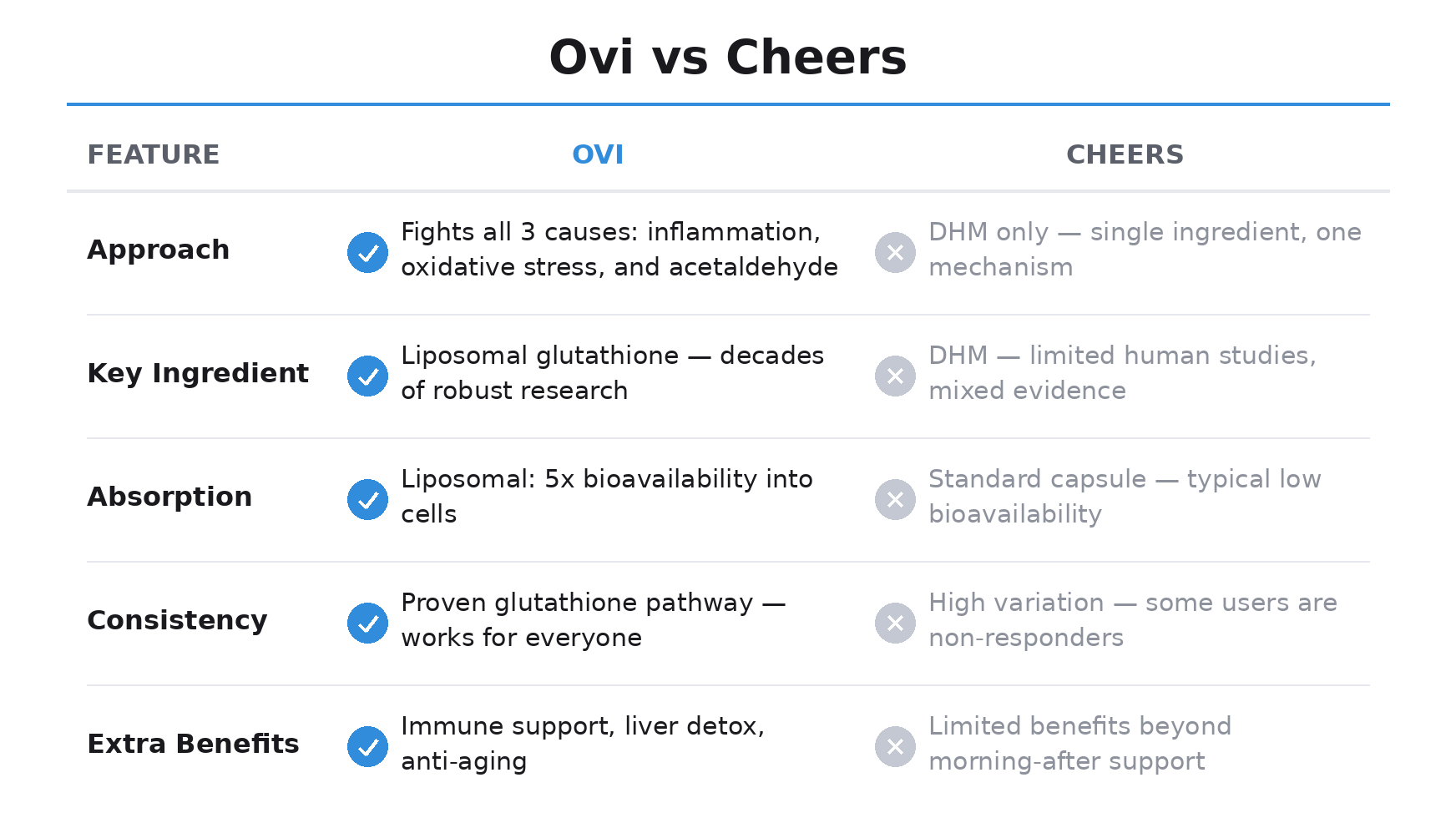
Two popular after-alcohol support supplements are Ovi and Cheers. While both aim to reduce hangover severity, they use different active ingredients and mechanisms. This comparison helps you understand the differences and choose the right product for your needs.
Ovi uses liposomal glutathione as its cornerstone ingredient, while Cheers uses DHM (dihydromyricetin), a plant compound. Both have research support, but they work quite differently.
What Is Cheers?
Cheers is a after-alcohol support supplement built primarily around DHM (dihydromyricetin), a flavonoid compound from the Hovenia dulcis plant. A typical Cheers dose is 1,200mg of DHM across 2-4 capsules, taken with water before or during drinking.
The Cheers approach is relatively simple: consume DHM pills and the active compound does its work. No special delivery technology is used; it’s just standard capsule formulation.
DHM: What the Science Says
How DHM Works
DHM is marketed as speeding up alcohol metabolism and reducing hangover symptoms. The proposed mechanisms include accelerating alcohol clearance from your bloodstream and providing antioxidant benefits.
The DHM Research
Research on DHM is mixed and limited compared to research on established antioxidants like glutathione. Some animal studies show promise, and a few human studies suggest modest benefits. However, the evidence is significantly weaker than the evidence for glutathione supplementation.
Most human studies show that DHM provides modest hangover reduction—perhaps 15-30% reduction in severity for some symptoms. This is real but modest. Additionally, individual responses vary considerably. Some people report significant benefits; others notice minimal difference.
The research is concentrated on a few small studies. Larger, well-controlled human studies examining DHM’s real-world effectiveness are limited.
DHM Limitations
DHM addresses only some hangover mechanisms. It provides some acetaldehyde metabolism support and modest antioxidant benefits, but it doesn’t address dehydration, glutathione depletion, NAD+ depletion, or inflammation as directly as other interventions.
Additionally, DHM is a single-mechanism intervention. If that mechanism doesn’t work optimally for you personally, you get minimal benefit. Ovi’s multi-ingredient approach is more likely to help everyone because if one ingredient doesn’t work as expected, others still provide benefit.
Ovi’s Glutathione Approach
Why Glutathione?
Glutathione is your body’s master antioxidant and primary defense against acetaldehyde toxicity. It’s extensively researched and scientifically well-established. Glutathione directly neutralizes acetaldehyde, protects cells from oxidative damage, supports liver detoxification, and helps prevent inflammation.
The Glutathione Research
Research on glutathione’s role in hangover prevention and recovery is extensive and consistently supportive. Glutathione levels directly correlate with hangover severity. Boosting glutathione reduces acetaldehyde accumulation and its toxic effects.
The evidence base for glutathione is substantially stronger than the evidence base for DHM. We have decades of research on glutathione’s biological roles and protective effects.
The Bioavailability Advantage
However, here’s the critical issue: standard glutathione has terrible absorption (5-15% bioavailability). This is why liposomal glutathione is so important. Ovi’s liposomal formulation achieves 50% or higher bioavailability—orders of magnitude better than standard glutathione.
This liposomal technology is the real innovation. It ensures that the glutathione you consume actually gets absorbed and makes it into your bloodstream.
Multi-Ingredient Synergy: Ovi’s AdvantageBeyond glutathione, Ovi contains curcumin (a potent anti-inflammatory), Clovinol (which enhances acetaldehyde removal), and other supporting ingredients. These work synergistically with glutathione to create comprehensive after-alcohol support.
Cheers, by contrast, is essentially DHM and not much else. This single-ingredient approach is simpler, but less comprehensive.
Inflammation Reduction
Cheers and Inflammation
Cheers has some anti-inflammatory properties, but they’re modest. DHM’s inflammation-reducing effects are limited compared to specialized anti-inflammatory ingredients.
Ovi and Inflammation
Curcumin, one of Ovi’s key ingredients alongside glutathione, is one of the most well-researched anti-inflammatory compounds available. The combination of glutathione and curcumin provides superior inflammation reduction compared to DHM alone.
Practical Considerations
Cheers: Pill Form
Cheers comes in capsule form, typically requiring 2-4 pills per dose. You need to take multiple capsules, swallow them with water, and time the dosing around your drinking.
The typical recommendation is taking Cheers 15-30 minutes before drinking or with your first drink. The capsules need to dissolve, be absorbed through your digestive system, and reach your bloodstream—all within a limited time window.
Ovi: Liposomal Liquid
Ovi is a liposomal liquid supplement, typically consumed as a shot (about 2oz). The liposomal form means superior absorption without the need to swallow multiple capsules.
The liquid form also allows flexible timing. You can take Ovi hours before drinking, right before, during your session, or after drinking. The flexibility is an advantage for real-world situations where drinking timing might be uncertain.
Speed of Absorption and Action
DHM in pill form needs to dissolve, be absorbed through the digestive system, and be transported through your bloodstream. This takes time. The enzyme systems need to be properly saturated with DHM for optimal acetaldehyde metabolism support.
Liposomal glutathione is absorbed more rapidly and efficiently. The liposomal encapsulation bypasses many absorption barriers, allowing glutathione to reach your cells and take effect more quickly.
Cost Comparison
Cheers costs approximately $30-40 per box for multiple doses, working out to roughly $7-10 per dose.
Ovi costs approximately $50-70 per bottle for multiple servings, working out to roughly $12-15 per serving.
Cheers is slightly cheaper on a per-dose basis, but the cost difference is modest. Given Ovi’s superior ingredient quality and bioavailability, many consider the additional cost justified.
Broader Health Benefits
Cheers Beyond Hangovers
DHM has modest antioxidant and anti-inflammatory properties, so Cheers provides some general wellness benefits. However, it’s not marketed or primarily indicated for general health benefits beyond hangover prevention.
Ovi Beyond After-Alcohol Support
Glutathione, curcumin, and Ovi’s other ingredients provide substantial general health benefits. Glutathione supports immune function, energy production, detoxification, and healthy aging. Curcumin is beneficial for inflammation reduction, joint health, cognitive function, and overall wellness.
If you value supplements that provide benefits beyond after-alcohol support, Ovi is the superior choice.
Individual Variation in Effectiveness
DHM’s effectiveness is highly individual. Some people are responders and experience significant benefit; others are non-responders and notice minimal difference. There’s less science explaining this variation.Glutathione’s mechanisms are well-understood and more universally effective. Because your body naturally uses glutathione for acetaldehyde defense, everyone benefits from boosting glutathione levels. Individual variation in response is smaller.
Liver Support
Cheers provides modest liver support through DHM’s antioxidant properties, but it’s not primarily designed as a liver-support supplement.
Ovi’s glutathione directly supports liver detoxification pathways and protects liver cells. The liver-supportive effects are more pronounced and deliberate.
Comprehensive Comparison Table
Active Ingredient: Cheers = DHM (1,200mg); Ovi = Liposomal Glutathione + Curcumin + Others
Research Support: Cheers = Moderate (limited human studies); Ovi = Extensive (decades of research on glutathione)
Bioavailability: Cheers = Standard absorption; Ovi = Liposomal (50%+ vs 5-15%)
Mechanism of Action: Cheers = Single mechanism; Ovi = Multi-mechanism (acetaldehyde neutralization, antioxidant, anti-inflammatory)
Inflammation Reduction: Cheers = Modest; Ovi = Significant (through curcumin and glutathione)
Form: Cheers = 2-4 capsules; Ovi = 2oz liquid (easier)
Dosing Flexibility: Cheers = Timing-sensitive; Ovi = Flexible timing
Cost per Dose: Cheers = Slightly lower; Ovi = Slightly higher
General Health Benefits: Cheers = Limited; Ovi = Significant
Choosing Between Them
Choose Cheers if: You prefer capsule form. You want the simplest possible hangover prevention approach. You like the idea of an ingredient from traditional Eastern medicine. You’re on a tight budget.
Choose Ovi if: You want superior bioavailability and absorption. You want comprehensive multi-ingredient hangover support. You want significant inflammation reduction. You value broader health benefits beyond hangovers. You want flexibility in dosing timing. You prefer scientific evidence with decades of research backing.
Can You Use Both?
There’s no reason you couldn’t combine DHM and liposomal glutathione. They work through different mechanisms and would be complementary. However, for most people, one product is sufficient for hangover prevention.
Practical Scenarios: Which Works Better When?
Scenario: Heavy drinker (8+ drinks in an evening). Ovi is likely better because it addresses multiple mechanisms and acetaldehyde accumulation more comprehensively.
Scenario: Moderate drinker (2-4 drinks in an evening). Either product might work well. DHM’s modest effects might be sufficient.
Scenario: Someone age 45+. Ovi is likely better because its glutathione directly addresses age-related declining glutathione production.
Scenario: Someone experiencing severe fatigue after drinking. Ovi’s multi-ingredient approach including support for cellular energy might be better.
Scenario: Someone who primarily experiences headaches. Either product might work. Cheers’s simplicity might be sufficient.
Scenario: Regular drinker (multiple times per week). Ovi provides benefits even on non-drinking days, making it better for ongoing support.
The Research Quality Difference
DHM research is primarily recent and relatively sparse. Most studies are small or conducted in animals. The human evidence is limited.
Glutathione research spans decades and involves thousands of human subjects across hundreds of studies. The evidence is robust, consistent, and well-established.
If you prioritize scientific backing and extensive research support, this difference is significant.
Absorption and Delivery: Why Liposomal Matters
This might seem like a technical detail, but it’s actually the most important difference between these products. Standard glutathione (which you’d get from most supplements) isn’t absorbed. Liposomal glutathione is.If Cheers included DHM in a liposomal form, its absorption would be better. If standard glutathione were used in Ovi, it would be much less effective. The delivery technology is often more important than the ingredient itself.
The Bottom Line
Both Cheers and Ovi offer after-alcohol support, but through different mechanisms and with different evidence bases. Cheers uses DHM (modest research support, modest effectiveness for some people). Ovi uses liposomal glutathione with extensive research backing and multi-ingredient comprehensive support.
If you want superior science, better bioavailability, broader health benefits, and more comprehensive after-alcohol support, Ovi is the better choice. If you prefer simplicity, capsule form, and lower per-dose cost, Cheers is a reasonable option. However, for most people prioritizing effectiveness, Ovi’s science-backed approach with superior absorption technology is the better investment.